Saturday, November 7, 2009

Compensations

As I said, thank god for the weather since that took a lot of the sting out of my lackluster performance today in tracking down these memorials. Below, some random shots from today's walk when I wasn't snapping pictures of plaques and flagpoles. As always, click on a photo for a larger view.

Prospect Park, in particular is beautiful around this time of the year and my walk around (most of) the lake was enjoyable.


And, despite having been through the
Sunset Park neighborhood on many occasions over the summer, today was actually the first time I was in Sunset Park itself. Talk about some views. Whew!


Fort Hamilton Parkway is always a pleasant place to walk, whether up by Ocean Parkway, alongside Green-Wood Cemetery (below), or further west toward Bay Ridge.


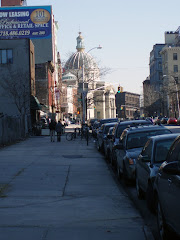
A Borough Park landmark, St. Catherine of Alexandria Church on Fort Hamilton Parkway.


On a day like this I probably should have taken the time to take more photographs but I didn't get back home until twilight as it was, so hadn't a lot of time for dallying around.

Because I added a Sunday entry to yesterday's memorial post rather than wait another week or two, I'll add a corresponding "compensation" here from my walk today (Sunday), which is the old Boys High School in Brooklyn, on Marcy Avenue in Bedford-Stuyvesant. A gorgeous Romanesque style building dating to 1892. Please clik on the link below for some background on it.

Boys High School of Brooklyn


Also a very pretty row of houses on St. Mark's Avenue between Brooklyn and Kingston Avenues, across from Brower Park.


Brooklyn War Memorials III

Thank god it was a nice day for a walk is all I can say; one of those clear, cool, crisp, sunny November days that make a walk out of doors a pure joy. Because that’s almost all I got for my efforts today: a nice walk outside.

I wanted to track down a few more of these war memorials and I chose some that I was certain would be in situ as they say. I guess that two out of four isn’t terrible; not great, but not terrible.


Bedford-Stuyvesant


There is another armory at Atlantic and Bedford Avenues in Bed-Stuy. I have to admit I had no idea that Brooklyn alone boasts so many. I know there is one in South Williamsburg, there is the one in Park Slope, and I have yet to get to another Bed-Stuy armory on Marcus Garvey Blvd., not to mention National Guard armories.


This is the 23rd Regiment Armory. On the outside wall to the right of the entrance is very large bronze tablet commemorating the men of the regiment who gave their lives in the war. Depicted is a battlefield scene, men charging out of a trench. The inscription reads: In commemoration of the men of this regiment who gave their lives in the World War. Also listed are twelve battles that the regiment fought in, among the Ypres, the Somme, and the Hindenburg Line.


There is no indication on the tablet or in my sources as to the date the memorial was installed.


Borough Park


I don’t know what the problem is with these triangular slivers of municipal property that are dedicated in commemoration of individuals or soldiers in general, but they always appear forgotten, unkempt and seedy. It’s funny, too, that they always seem to be up against an elevated highway or elevated subway line. It’s as if once they’re dedicated, everyone forgets about them.


Alben Square is formed by the crossing of 46th Street, 11th Avenue, and new Utrecht Avenue in Borough Park. It’s a block from Fort Hamilton Avenue and the D train station there, and despite its name it is a triangle, not a square. And as you can see, it really does sit “in the shadow” of the elevated tracks

.


There is a flag pole in the center of the triangle with a tablet mounted on the pole’s concrete base. By enlarging the photo I took, I was just able to make out the words. You can’t read it while you are actually there because the tablet is so dark as to be almost indecipherable. Also there is an iron fence completely surrounding it with chains locking what look like gates on either side. I probably could have climbed over, the fence isn’t that high, and I doubt that anyone would have given me a second glance. But somehow it just didn’t seem worth the trouble.


The memorial was erected by the Private Budd H. Alben Post of the V.F.W. in 1935. The inscription reads: Erected in memory of the Veterans of Boro Park who made the supreme sacrifice. At the top is the phrase “Lest We Forget.”


I didn't think there was much sense in holding the following for another post because It will be at least a week if not longe before I get out again. Sunday's weather being as superb as Saturday's, I went out in the afternoon to see another nearby memorial I had inexplicably missed (probably coming within a few blocks of it on any number of occasions).


Bedford-Stuyvesant once again


Now, this is what I call an armory. I can imagine this place stocked with weapons; not small arms and rifles but mauls and maces, halberds and pikes, swords, shields, and chain mail. It looks like the lair of the Baron of Bed-Stuy. The Atlantic Ave. armory is oppressively large, this one is perfect.


It was the home of the 13th Regiment (254 Coast Artillery) of the New York National Guard. It is now the headquarters of the Black Veterans for Social Justice which helps with temporary housing for homeless men, vocational training, employment referrals, and so on.


The memorial to the men of the Coastal Artillery who died in the war is a free-standing granite one that stands behind a fence in front of the building. It is very large and contains an enormous number of names and other information in very small type on a central bronze panel. In fact, I'm not sure if all the names are of individuals who died in the war or just served in the war. It seems like an awful lot of names from one group. The historical society's booklet simply calls it an honor roll. The bronze is so weather-worn that it's hard to decipher some parts.


On either side of the central panel are two more depiciting battlefield scenes, one of which is shown above.


This was also behind a high fence that I had to stretch over the top of on tip-toe to try to get the shots. It needs a good cleaning and is also starting to come off the wall in the upper right. A few small pieces at the bottom in the center also look like they're missing.


A Map showing the location of these memorials


What Couldn’t I Find?


Along the way from the Atlantic Avenue armory to Borough Park, I cut through Prospect Park. I had to stop at the library anyway. It seemed a good opportunity to search for the monument that is supposed to be along the lake. My source describes it as a


crescent-shaped granite monument with a heroic bronze group and six bronze tablets, by Augustus Lukeman with Daniel Chester French associated with him


Now that sounds like too large a group to have disappeared or been removed. But I walked all around that damn lake this afternoon and couldn’t find a trace of it. I am thinking it has got to be there and I’m just not seeing it for some reason. I don’t know Augustus Lukeman but no one gets rid of something Daniel Chester French had a hand in. And it’s not like Prospect Park is getting crowded and they needed the room. I’ll find it if it is there.


I was disappointed, too, at not finding the bronze plaque on the four-foot-high granite base that was supposed to be at the head of the steps leading up into Sunset Park from Fifth Avenue, but that wasn’t there either. I suppose it could have been relocated to another part of the park, which is pretty large. Another trip back there.


Wednesday, November 4, 2009

Brooklyn's War Memorials II

Just a short note before moving on to the next group of memorials: at the end of this post you may link to a map showing all the locations covered in Brooklyn War Memorials I and II.


Brownsville


A bit sad, too, is Zion Triangle, a dreary, cracked concrete covered sliver of park at the intersection of East New York Avenue and Pitkin Avenue near the northern edge of Brownsville, just down the hill from Eastern Parkway. It didn’t exactly help to lift my spirits that the day I visited was chilly and cloudy and that there is a lot of construction equipment parked along the East New York Avenue side.


It’s hard to tell whether anyone takes particular care of the memorial. I would guess not. But the general area looks clean and swept and the little shrubbery nearby looks trimmed. There are park benches along both sides so it’s no doubt kept clean for the use of the neighborhood. But it doesn’t look like the kind of place where anyone is going to leave the kind of red, white, and blue wreathes that I saw in front of the Fighting Doughboy. Then again, many monuments are decorated on Veterans Day and Memorial Day even if at no other time of the year, and this one may be.


But it’s too bad that it’s not better cared for because the names of the 92 Brownsville men memorialized are still clear and legible on both sides of the monument and surely their memories deserve some respect.


As the name of the park indicates, most though not all the men memorialized were Jewish (though the park name came before the monument). The Neighborhoods of Brooklyn mentions that at the turn of the 20th century Brownsville was called the “Jerusalem of America.” And one of the sponsors of the memorial was the Jewish Veteran of the Wars of the Republic. The other groups involved were the Citizens Memorial Committee, the American Legion, and the Veterans of Foreign Wars.


The limestone memorial occupies one entire end of the park and is approached by broad shallow steps; the space in front is flanked by two walls about a foot high. The central portion of the monument shows, in bas-relief, a winged female figure brandishing a sword and shield. Inscribed on the limestone walls on either side of the central figure are the names of the men honored.


Facing out on one of the small walls is carved the Star of David; on the other side is the Great Seal of the United States, both in pretty good shape considering that the memorial was unveiled in 1925, but limestone is said to stand up well to exposure.


It looks like there might have been some kind of upright pillar or post on either corner at the front but all that remains on one side is a stub and nothing on the other side.


Park Slope


An ideal location for a war memorial is occupied by the larger than life bronze figure of a charging soldier in front of the 14th Regiment Armory on Eighth Avenue at 14th Street in Park Slope. It dates from 1923 and is dedicated to the men of the 14th Infantry who were engaged in the war.


I like the medieval castle architecture of the typical armory and it provides a perfect setting for a statue like this, but see one armory and you’ve pretty much seen them all. The Park Slope building isn’t bad as armories go, not as overwhelming as others I’ve seen around Brooklyn. It fits the neighborhood well.


If the inscriptions sound a bit high flown and poetic it’s because they’re from poems entitled “Marco Bozzaris” (Strike for your altars) by Fitz-Greene Halleck, a now mostly forgotten 19th century American poet who was known in his time as the American Byron; and The Lays of Ancient Rome (And how can man die better) by Thomas Babington Macaulay.


Carroll Gardens


Carroll Park, between Court and Smith Streets in Carroll Gardens boasts an impressive monument dedicated to 187 men from that district who lost their lives in the war. It consists of a tall granite shaft faced with four bronze plaques.


One plaque features a sailor, another a soldier, and the other two sides feature the names of the memorialized men. It was erected in 1921 by the Memorial Committee of the 8th Assembly District.


It is an imposing monument but brought down to size by it’s setting, the wide plaza surrounding it and the old growth trees towering over it. The plaques were designed by Eugene H. Morahan.


Downtown Brooklyn


A simple granite monument stands outside McLaughlin Park at the corner of Tillary Street and Flatbush Avenue near the approach to the Manhattan Bridge.


It features an eagle with spread wings carved into the surface of the stone and the names of sixty nine men inscribed on the front and rear. It was erected by the Seawanhaka Democratic Club in 1919. It’s a clean, unassuming memorial set back slightly from the street and flanked by two rows of upended artillery shells, an interesting touch.


Williamsburg


Memorial Gore (formerly Woodpoint Gore), is another splendid little sliver of land where Bushwick Avenue, Metropolitan Avenue, Maspeth Avenue, Humboldt Street, and Woodpoint Road collide and fight it out among themselves in Williamsburg. As apt as it sounds for a war memorial, this isn’t the gore of Patriotic Gore, blood and gore, or even Al Gore. Gore in this case comes from an Old English word “gara” meaning just a triangular piece of land There is also Cuyler Gore in Fort Greene, a very pleasant park despite the name.


This isn’t really my favorite among all these memorials. For one, it’s in a very inconvenient place, isolated in the middle of some very heavily trafficked streets and not easy to get to. No matter where I was standing one line of traffic always seemed to have a green light so I couldn't cross.


And when you get over to it, it’s still inaccessible. Most of the other memorials, even if fenced in, let you get close enough to them at least to read any inscriptions, This one is placed just far enough away from each side, and behind iron fences and shrubbery just high enough, to pretty much block any good view. The only way I could get any shots was to wrap the camera cord around my wrist, stick my arms through the fence, try to hold the camera straight, and hope for the best.


And I’m just not crazy about that triangular column with the globe with the smaller globe with the eagle. It reminds me of a geometry exercise or a child's toy.


Still, all of that no doubt helped to keep it in pristine condition. And it is still there, something you can’t say about Novelli's work in Saratoga Square Park. It was erected in 1921 to memorialize the “patriotism and devotion of the men of the 13th Assembly District,” who served in the war in 1917-1918. The names of 83 men are inscribed on the shaft. The sculptors were the Piccirilli Bros.


More after my next foray out into this beautiful borough. Maybe I will wait until after Veterans Day to see which monuments were decorated for the occasion.


P.S. Still no crosses, Justice Scalia.


A map of the locations in Brooklyn War Memorials I & II

Monday, November 2, 2009

Brooklyn's War Memorials I

Several things crashed together in my brain recently and resulted in this posting. First, during my wandering around Bushwick this past summer, I came across a couple of well cared for war memorials dating back to the First World War. Either I don’t notice those things when I pass by them, or there aren’t that many to begin with and it was just coincidental that I should happen on two within several blocks of each other around the same time. In any case, it spiked my curiosity about whether there were others around Brooklyn.

.

The second object in the brain collision was a story that was covered in the New York Times around that same time about a cross used as memorial in the Mojave National Preserve in California. The cross was erected by VFW post in California in the 1930s and a retired National Park Service employee objected to its being on federal land. The case reached the Supreme Court last month. In oral arguments, Justice Antonin Scalia grew rather testy, according to reports, at the suggestion that perhaps non-Christians might object to being memorialized by a Christian symbol. Scalia retorted that the cross was the most common symbol memorializing the dead and that it didn’t memorialize only Christian soldiers.


The Constitution and the Cross


Religion Largely Absent in Argument about Cross


Also, three, November 11 draws near; Armistice Day, Veterans Day.


Since the two war memorials I saw included no religious symbols at all, I thought of tracking down as many as remained in Brooklyn to find out what symbols were used in war memorials, at least the ones dating to World War I. I was lucky to find a small book published by the Brooklyn Historical Society in 1952 listing historical markers and monuments in Brooklyn, with a separate listing of World War I monuments (it was published under the society's previous name of Long Island Historical Society). It is simply an alphabetical listing with no photos.


Well, fifty-seven years have seen some big changes in various parts of Brooklyn and I wasn’t surprised that I couldn’t find all of them, but I did find some. And my search isn’t over yet. These memorials are located in different parts of Brooklyn, miles apart, and since the spirit of this blog calls on me to walk wherever I am going, it’s taken a hell of a lot of foot work to get to the ones I’ve found up to now. And up to now there’s been nary a cross among them.


Prospect Heights - Crown Heights


First I want to show you what I think are surely the most overlooked memorials to the fallen of World War I. I noticed these last summer purely by accident when I happened to look down as I wandered along Eastern Parkway. At the base of trees along the promenade on both sides of that boulevard are small plaques set into the ground with the name and service information of a Brooklyn resident who was killed in the war. In each case, a tree was planted in his honor. And I say “he” deliberately because I have yet to find the name of a woman among the plaques.


I read later that these were also to be found around the fountain at Grand Army Plaza, at Borough Hall, and in other parts of Brooklyn. The only ones I have noticed are along Eastern Parkway from the library to beyond Washington Avenue as far as I can remember, maybe further. I think it’s amazing that the plaques remain though many of the trees have been replanted. At least many of the trees don’t look over seventy years old to me (almost all these memorials date from the 1920s).


I found close to fifty of these plaques along Eastern Parkway and will probably look around Borough Hall to see if the ones there are still in place.


I won’t take the others in any particular order except that this first group is located mainly in the northern and eastern sections of the borough since I took the ones closest to home first.


Greenpoint


Monsignor McGolrick Park in Greenpoint. When the memorial was erected this was known as Winthrop Park but it was renamed in honor of the pastor of nearby St. Cecilia’s church in 1941, three years after his death. The memorial consists of the bronze figure of an angel on a granite base (okay, maybe an angel could be considered a religious symbol though not necessarily exclusively Christian).


There is an inscription on the front memorializing the “dead heroes of Greenpoint,” and on the other three sides are inscribed the names of several major battles that presumably these men died in: St. Mihiel, Somme, Chateau Thierry, and Argonne. The statue is by C.A. Heber.


A perfect location in the park was chosen for the statue, in front of what could almost be taken for a classical triumphal arch especially designed to frame it. But on further examination, the arch turns out to date from several years before the war and probably a good ten years before the statue was erected; it is known officially as the Shelter Pavilion. Still, it does provide the perfect backdrop.


And since I’ve never been one to stay completely on topic let me go just slightly off topic now to mention another monument on the other side of the arch; it is war-related though not to World War I. I’m not sure how many people realize it but the famous Civil War ironclad Monitor was designed and built in Greenpoint and later launched from the Brooklyn Navy Yard. The second monument in Msgr. McGolrick Park commemorates the battle, the men of the Monitor, and the designer, John Ericsson.


Msgr. McGolrick Park itself is, I suspect, another of those well-kept Brooklyn neighborhood secrets. I wonder how many people living nearby but outside of Greenpoint realize that they have this beautiful park practically on their doorstep. But because it’s on the way to nowhere in particular except the eastern edge of Greenpoint, the back end of Newtown Creek, and the swamps of Maspeth, I’m sure a lot of people in nearby Williamsburg probably don’t know it exists.


Not too many blocks away from the park is a small triangle of weedy ground in the shadow of the Brooklyn Queens Expressway. Well, maybe weedy is doing it a slight injustice but it’s certainly unassuming. It’s known as Fidelity Triangle and was the location of another, more traditional type of war memorial: a German cannon captured during the war. The cannon was presented to the city to place in the park by the Fidelity Council of the Knights of Columbus in memory of the soldiers who died in the war.


The Historical Society guide lists several Brooklyn memorials consisting of captured German cannons, but unfortunately none remain, their having been sacrificed to scrap drives during the Second World War. Each was said to have been replaced with a flagpole, as indeed the cannon at Fidelity Triangle was, but it’s just not the same as a cannon. As you can see, even this flag is pretty sad. And when one considers it, that even a conservative Roman Catholic organization like the Knights of Columbus chose a cannon over a cross for a memorial seems to give to lie to Mr. Justice Scalia.


Now that I think about it, one reason this place seems so forlorn to me is that it's smack up against the B.Q.E.; it seems to be lost, away off on the edge of things. But when this little park was dedicated and the cannon placed, there was no B.Q.E. and it may have looked like a much pleasanter place. Mr. Moses no doubt accomplished many fine things for New York City but the Brooklyn-Queens Expressway was not one of them.


Bushwick


Up Broadway at Stuyvesant Avenue is another example of a missing-cannon memorial park (above), though this one is in better shape and actually still contains at least the base that the cannon once rested on. (And these are the only two I am going to show here, there's no sense in wasting too much space on something that isn’t there.)


This small park is Beattie Square, named after a local resident, Joseph S. Beattie, who died on a battlefield in France in October of 1918, only a month before the armistice. The small park was said to have been renamed for Beattie at the insistence of the Beattie VFW post in 1921. In 1924 a 12, 000 pound German Krupp gun was placed there but it, too, was lost to a World War II scrap metal drive. The park seems to be well-cared for with well-tended shrubbery and trees.


Not too far away at Willoughby, Myrtle, and Bushwick Avenues is the “Angel of Peace” in Freedom Square (above). This was the first of the memorials to catch my eye during my summer walks. It was erected three years after the war in 1921. It commemorates the men of the 19th Assembly district who died in the war. It is similar to the statue in McGolrick Park, a bronze angel striding forth, carrying a sword in one hand and holding aloft in her other hand what appears to be a palm branch. The sculpture is by Pietro Montana.


The site doesn’t seem very well-tended and the weeds have grown up around it, though perhaps when I saw it, it was between groomings. And considering that it’s at a pretty prominent intersection, it appears almost lost, off to the side under some trees in the shadow of the M train, and easily overlooked. Then again, probably more cars go through this intersection than people these days and that might lend it a certain air of neglect.


About four blocks away deeper into Bushwick, also on Myrtle Avenue (at Knickerbocker Avenue) is “The Fighting Doughboy.” This is also by Pietro Montana and was also unveiled in 1921. Mr. Montana was keeping very busy around that time since he was also responsible for a statue in Highland Park that I haven’t yet seen (assuming it is still there) that was unveiled in 1925.


The doughboy statue and park appear better tended than the angel of peace. When I last saw it, there were three large wreathes placed there by, I believe, American Legion Post 1815. The plantings are much better cared for also. Well, this small park, known as Heisser Square, is in a more bustling part of the neighborhood at the head of Bushwick’s busiest shopping street so probably more attention is paid. Again, no cross, but the figure of a soldier from World War I, one fist clenched, a rifle in his other hand, his helmet at his feet, and looking ready to take on the world.


The historical society guide mentions a field gun that was part of the monument and that was lost to the World War II scrap drive. It was to have been replaced by a flagpole from the 1939-1940 World’s Fair in Flushing Meadows, however I don’t recall seeing a flagpole there. There should be one, there almost always is, but I can’t see one in any of my photos.


Bedford-Stuyvesant


Perhaps a mile further south in Bedford-Stuyvesant is Saratoga Square Park, a quiet, leafy retreat a block from Broadway between Saratoga and Howard Avenues. Here, all that remains of a memorial is a bare granite shaft stripped of the bronze tablet that is described as “a bronze figure of an angel in relief” against the granite shaft. It was inscribed in memory of the heroic dead by the residents of districts 31 and 32, with a list of 106 names.


Sad. When I found Saratoga Park and took the picture last month, I didn't know the background to this vandalism. The memorial actually was complete up to nine years ago. As Mr. Monk would say, here's what happened:


Statue from War Memorial Stolen


But I was able to find a photo of it when it was complete at this site. It really was a gorgeous monument:


Novelli Statue in Saratoga Park, Brooklyn


More in the next posting. On to Brownsville, Park Slope, Carroll Gardens, and more . . .