Sunday, September 5, 2010

On to Clinton Hill


I think when last I left these posts, I was on my way from Bed-Stuy into Clinton Hill. Real time and walk time are usually so far apart that if it weren't for my razor sharp memory along with the audio files attached to my photos, I wouldn't know where I was.

The cute little house below is a block away from the final photos in the last post. Close one eye and it looks almost like a miniature Bates Motel house.

Cambridge Place near corner of Gates Ave.

And a block away from Cambridge Place, at St. James Place, a block party was getting into full swing.

Gates Avenue and St. James Place

Gates Ave. and St. James Place

With the sudden beautiful weather that weekend, that Saturday was the day for block parties, outdoor gate sales, yard sales, whatever. A block from St. James Place is Washington Ave., rightly noted for its brownstones and other remnants of the Gilded Age.

There are two large churches in that area and one of them, the Brown Memorial Church, was having its own church street sale that day.

Brown Memorial Church, Gates and Washington Aves.

Brown Memorial Church, Gates and Washington Aves.

Brown Memorial Church, Gates and Washington Aves.

I was going to say that Clinton Ave. was a block away but I generally forget that Waverly Ave. lies between them. It's not a prominent street and I for one tend to forget it's there until I cross it. So, two blocks farther on is Clinton Ave., the street that gives the neighborhood its name.

This young man was sitting alongside the sidewalk on Clinton Avenue between Greene and Gates Aves. giving an impromptu recital. I think he and his girlfriend were setting up another small yard sale. I asked to take his picture, which he politely allowed me to do. I explained to both that I had this blog and might want to add the photo to the blog. But I warned them that for me, keeping up with the postings was difficult and maybe I wouldn't get to it right away. Well, here it is. Only a month later. That's nothing when I think of all the walks from last summer that I never covered here at all!

Washington Ave. between Gates and Greene Aves.

This photo points up a great thing about the Clinton Hill neighborhood, it's a great place for casual strolling. To me, it has always seemed to be to be a very neighborly sort of place; a kind of tip-your-hat, stop-and-chat nabe. Technically it ends in another block at Vanderbilt Ave. where Fort Greene begins, but in reality the two neighborhoods blend into each other seamlessly.

Speaking of Vanderbilt Ave., I want to throw in a couple of shots here from an earlier walk. Actually, it wasn't a walk at all, it was from two mid-week forays to the library after work by bus; mid-May and mid-June, the last a quiet summer evening, just two days past Midsummer Eve, my favorite time of the year.

Vanderbilt and Park Aves.

Whenever I take the bus to the library (either for lack of time or bad weather), I transfer to the B69 right across the street from these houses, so I've had plenty of time to enjoy them in all weather at different times of the year. But mid-Summer for me is the most magical time.

Vanderbilt and Park Aves.

According to the nyc.gov map I use, the houses date from between 1840 and 1850. To me they are three little gems, yet they are right on the edge of what was the industrial section of that part of Brooklyn, and only a block away from the Navy Yard, so probably when they were built they were just three unassuming laborers houses looked down on by the gents further up in Clinton Hill.

Vanderbilt and Park Aves.

I should say "two" little gems since two of them have been restored but the corner one is still pretty much of a shack.

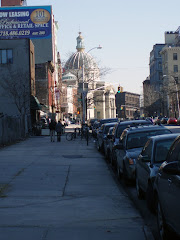
Now before I end for tonight (since it's getting pretty late), I want to add that other prominent church I spoke of earlier. It is an enormous church on Clinton Ave. between Fulton St. and Atlantic Ave., St. Luke & St. Matthew.

Since I cut up through Clinton Hill and Fort Greene whenever I walk to the library, these buildings have become like old friends I use to mark my progress.

Clinton Ave. between Fulton St. and Atlantic Ave.

Next time . . . on to Bay Ridge . . . or at least South Brooklyn.

Tuesday, August 31, 2010

Jumping Feline Part 2

Side trip from May


Quincy Street looking from Franklin Ave. to Bedford Ave.

Way back at the beginning of May, when summer held such great promise, I was wandering through that neighborhood from my previous post, but a block away on Quincy Street. I won't say the difference is like night and day but a block away it is less commercial, more settled and comfortable, and possibly a little more immune to the scourge of redevelopment. Which is not to say that the occasional brownstone or row house doesn't fall prey to a developer. All I did was turn 180 degrees to take these two pictures. Why don't they ever attempt to make it blend?

Quincy St. looking toward Franklin Ave.

Just up at the corner of Franklin Ave. across the street from that gray box is my kind of building; colorful, decorated, interesting to look at. What is there to see in those other boxes after you've glanced at them once?

Quincy St. at Franklin Ave.

In fact, walk around the corner to the left and you will find a house that almost burned down.

Franklin Ave. between Quincy St. and Gates Ave.

It's a measure of my dislike of the ubiquitous blue or green glass and steel boxes or concrete boxes that even that half-burned out house looks better to me than anything that gets built today.

And next to that is the Evening Star Baptist Church that is boxy and looks like it might be
faced with cement and but is still a better building than anything being thrown up these days.

Gates Ave. at Franklin Ave.

And on the opposite corner is another favorite building of mine in that neighborhood.

Gates Ave. at Franklin Ave.

Walking down Gates toward Classon I found this quirky and colorful building. Too quirky and too colorful to last too much longer, probably. Why keep something like this when you can replace it with a perfectly bland and colorless nonentity?

Gates Ave. between Franklin and Classon Aves.

At the end of that block, at the corner of Gates and Classon Aves. is, to be fair, a building that almost makes it, almost fits in. But hey, let's not make it a mellow red like the rest of the block, let's make it stand out, a nice cold banker's gray. So chic and so "now" you could almost faint from sheer emotion.

Franklin Ave. at Classon Ave.

But then there is this mellow neighborhood church, the Mt. Zion Tabernacle, a block away at Franklin Ave. and Irving Place.

Franklin Ave. at Irving Place

But, walk a couple of more blocks to Grand Ave. at Gates where we left off last time and, we're not in Kansas anymore, Toto. We're in Anytown USA, circa nineteen-aught-one, we are, except for those damn cars, In the Good Old Summertime, where a young man with a straw boater and a striped blazer will run down those steps any moment.

Grand Ave. between Gates and Putnam Aves.

Grand Ave. between Gates and Putnam Aves.

Grand Ave. between Gates and Putnam Aves.

Grand Ave. between Gates and Putnam Aves.

We are, in fact, wandering into Clinton Hill, where we'll get back to my July walk next time.

Saturday, August 28, 2010

Which way will the cat jump?


Summertime, and the pavement was baking,

Sun was burning,

And was blistering my head

Oh, I got a bone,

Spur all in my left heel, yeah,

I can’t do no walkin’

And I’m feelin’ so blue.


(Sincere apologies to Mr. DuBose Heyward and Mr. George Gershwin.)


This has not been the summer I had hoped it would be, mostly because of the sun and, latterly, a bone spur that developed in my heel (too much walking, maybe?). In fact, over all I'd have to call it a disappointing three months.


I spent most of the time around Williamsburg and Bedford-Stuyvesant; up Broadway, out Bedford and Nostrand Avenues, cutting through on my way out to the library. The only good long walk I took was on the last day of July when the heat broke and I ambled out to Bay Ridge and the Verrazano Bridge, and even that was a last minute decision that I took while walking around downtown.


Oh, well; best laid plans and all that.

I do especially enjoy wandering through the western edges of Bed-Stuy, the part nearest Clinton Hill, since this seems to be the area of Bed-Stuy most in transition these days. The Hassidic community of South Williamsburg is growing out along Bedford Avenue, Franklin Avenue, and Skillman Street among others, while the young people attracted to Brooklyn these days because of its trendiness see Bed-Stuy as a cheaper alternative to Williamsburg, Clinton Hill, and Fort Greene . . . among others.

Looking down Bedford Ave. from Myrtle Ave.

It's definitely a question of waiting to see which way the cat will jump; into a wholesale gutting of parts of the neighborhood, an attempt to integrate the new with the old, a quick and cheap grab at profits, which?

Bedford Ave. between Willoughby and DeKalb Aves.

The building that caught my attention most recently is an old church at the corner of DeKalb and Bedford Avenues. It was originally St. Peter's Lutheran Church, built in 1867, and around the turn of the century one of the largest Lutheran churches in Brooklyn with property valued at $100, 000, I'm no math wiz but I'd guess that $100, 000 in 1891 was a pretty tidy sum.

Bedford Ave. at DeKalb Ave., tower of St. Peter's church rising over the trees.

It's on the block now.

St. Peter's Church. Bedford Ave. near DeKalb Ave.

You can tell something's not quite right when you see a small sapling growing out of the belfry.

St. Peter's Church, Bedford Ave. near DeKalb Ave.

Of course, they could do a Limelight and save the church building but put it to another use. In fact, the notices there are somewhat confusing, between "retail space available" and "development site for sale" it sounds like the owners will take the most profitable and least complicated route.

If the structure does come down, well, new buildings haven't always been kind to the neighborhood. One can hope for the best.

Bedford Avenue and Clifton Place

Clifton Place is just two blocks farther down (south) of DeKalb Ave. and is a fascinating street in itself; fascinating because it is, again, one of those streets that changes from block to block. But I'm not going to go off on a tangent about Clifton Place right now. Maybe later.

A block beyond Clifton Place at Greene Avenue and Bedford Avenue.


Another block of those ordinary red brick buildings that were probably going up all over Brooklyn at the turn of the century. There's nothing spectacular about them, but maybe it's their sheer ordinariness, the fact that they've been where they've been so long and don't call attention to themselves that makes me prefer them to the newer stuff. That building on Clifton Place doesn't call attention to itself, it SCREAMS it.

And here are a few more . . .

Bedford Ave. at Greene Ave.


Greene Ave. at Franklin Ave.


Lexington Ave. at Franklin Ave.


Lexington Ave. at Franklin Ave.

At which point another map might be in order, courtesy of the New York City Department of Internet Technology . . .


Now, to be perfectly fair to any developers and builders, not every block in that area is lined with old brownstone or brick row houses and shaded by hundred-year-old trees. It's a mixed area of the residential and the commercial and some blocks are pretty dreary. Not that the new building does anything to brighten the blocks up, it just doesn't do anything to damage anything better.

Lexington Ave. between Classon and Franklin Aves.


Lexington Ave. between Classon and Franklin Aves.

Lexington Ave. between Classon and Grand Aves.

Lexington Ave. between Classon and Grand Aves.

I don't know if that factory above is still operating. If not I'd prefer that someone renovated it into apartments rather than tear it down and replace it with some green- or blue-glass and steel monster.

Across the street from the above building is the one below that has been turned into living space. Nice! Keep the greenery and just add people.

Lexington Ave. between Classon and Grand Aves.

Now it just happens that around the corner from those two buildings above is a perfect example of two different ways to handle this problem of new building in old neighborhoods.

Lexington Ave. dead ends at Grand Ave. and you can go either right to Greene Ave. or left to Gates Ave. Along the western side of Grand from Lexington to Gates is a row of old, tree shaded homes, brownstones mixed with others.

Grand Ave. from Lexington Ave. looking toward Gates Ave.

Grand Ave. looking from Gates Ave. toward Lexington Ave.

In the opposite direction, toward Greene Ave., there is new building, but directly across the street from the houses above there was also some new construction, and you can see that the developers made two very different choices, one to try to blend in and the other, seemingly, not to bother.

Grand Ave. from Gates Ave. toward Lexington Ave., directly across the street from the two photos previous.

Grand Ave. from Lexington Ave. toward Greene Ave. A different block, a different decision.

It's almost midnight and I am going to take a break now. The pictures above are from my walk to Bay Ridge at the end of last month (the start of the walk before I had actually decided to go all the way out to the bridge).

Since I've had the problem with the bone spur in my heel I haven't been able to walk much, but I have been so anxious to track down the last two Carnegie libraries in Brooklyn that I hadn't seen, that I figured today, the hell with it, I'd just take buses.

Well, let me tell you, walking is a breeze compared to busing. To get where I wanted to go I had to take four buses, the 62, 41, 12, and 14; going and then coming back. It took six hours altogether what with transfers and heavy traffic on some routes. The sooner I get back to walking the better.

Friday, July 9, 2010

Nexus, Sexus, and . . . Millard Fillmore


Williamsburg has an historic/literary site and an actual historic district, even if it is barely a block long. And I don't mean the Domino Sugar factory.

Henry Miller, probably acclaimed and reviled in equal measure, lived on Driggs Ave. as a child. His childhood home still stands, somewhat isolated, between Grand Street and Metropolitan Avenue, with a grass off-street parking lot on one side and a marble and granite storage yard on the other.

Henry Miller's childhood home, 662 Driggs Ave., Williamsburg


In his writings he was said to have described being enchanted by Fillmore Place, a short block of row houses that runs between Driggs Ave. and Roebling St. around fifty feet or so south of his home.

Fillmore Place from Driggs Ave. to Roebling St.

I read a few years ago that there was an application before the city to have Fillmore Place declared an historic district and I have to confess that I thought it was a joke. It turns out that the laugh is on me because a little over a year ago, without much fanfare that I can remember, Fillmore Place was declared a city historic district.

Fillmore Place, north side from Roebling St. to Driggs Ave.

It is said that the houses all date from the 1850s when Williamsburg was just starting to change from a "rural village to an urban neighborhood." That's another indication of just how wrong the city map on nyc.gov is in it's building information, since it claims that all the buildings there date from 1899 except for one or two that were built in 1915 and 1920.

Fillmore Place, south side from Roebling Street to Driggs Ave.

So, I raise my Corona in a toast to Henry Miller, Millard Fillmore, and his place. It's probably the most respect that accidental, pro-slavery president has gotten since his death.

Fillmore Place near the corner of Driggs Ave.