Wednesday, January 13, 2010

No Winter Walks!! Stuyvesant Heights and Other


I have curtailed my walks around our beautiful borough until the warm weather returns. I am not what you would call a “winter” person. The best temperature for optimum performance of this walker is around 85° with a nice healthy high humidity level. I am still walking to the library of a weekend but I take the shortest, most direct route. And I have even been known to take the bus home though it means standing at a windswept bus stop at Grand Army Plaza waiting for the B69, which runs only every half hour on weekends, since that's better than an hour walk in a biting wind.


A pleasant block in Stuyvesant Heights


More Stuyvesant Heights brownstones


I did try, honestly I did. About a week before Christmas, I wandered out into Bedford-Stuyvesant, a rich and varied neighborhood, but I didn’t enjoy it. Too much stopping to take my gloves off, snap a picture, put the gloves back on, etc.; and much too chilly to be pleasant. Even my photos didn't come out very well, maybe my hands were shaking and blurring the image.


A house on MacDonough Street


St. Philip's Anglican Episcopal Church on MacDonough Street


There are some beautiful blocks in the Bed-Stuy-Crown Heights area and I’ll drop in a few photos here from that Saturday and from a walk a few (warmer) weeks earlier. But the rest of Bed-Stuy may have to wait until spring.


Brower Park, the Kingston Avenue side


Prospect Place off Kingston Avenue across from Brower Park


Above and below are some blocks in and around Stuyvesant Heights, an area of about four square blocks on the western edge of Bed-Stuy, near Fulton Street. Nearby Stuyvesant Heights, also along Fulton Street, is Fulton Park with a statue of Robert, um, oh yeah, Fulton.


Statue of Robert Fulton in Fulton Park


Chauncey Street along the edge of Fulton Park


Further west, several blocks beyond Atlantic Avenue and either in Bed-Stuy or Crown Heights, depending on how you view the matter, is Brower Park, where there is an interesting looking church. Brower Park is where there was supposed to be an elaborate memorial to the fallen of World War I. It's not there any longer, though there is a small stand of trees planted in honor of Theodore Roosevelt that can be seen in the photo of the park earlier in this post. I'd like to find out what happened to that memorial. It may have been displaced by a basketball court, a playground, or even the Brooklyn Children's Museum that occupies one corner of the block.


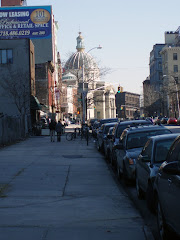
First Church of God in Christ, Kingston Ave. & Park Place


Also on the edge of Stuyvesant Heights is one of the more interesting looking Carnegie Libraries, the Macon Branch, now undergoing some renovation. It's at Lewis Ave. and Macon St. I've tracked down most of Brooklyn's Carnegie Libraries since all but, I think, three still remain. I'll get to them later in the spring also.


And just for comparison's sake: Boys High School (pictured in a previous post) and Girls High School a few blocks away. Both were designed by the same architect.


Boys High School (above)


Girls High School (below)


From the size of the buildings I'd say they expected a lot more boys than girls to go to high school!


I suppose I could use the winter months to add photos from summer walks that I didn’t put in here earlier, but that depends. I still try to walk home from Manhattan on weekdays but even if I don’t, I just want to sit over a cup of hot tea and a good mystery book at night so not much blogging will get done.


Monday, November 16, 2009

Cypress Hills National Cemetery: Amplification

Cypress Hills National Cemetery vs. Cypress Hills Cemetery


Amplification and correction.

I don't blame the book since the situation out there in cemetery land can be very confusing.

I relied on a sidebar in The Neighborhoods of Brooklyn for my information on Cypress Hills National Cemetery. The sidebar is titled: Cypress Hills Cemetery. The first sentence explains that Cypress Hills Cemetery was made a part of the National Cemetery System in 1862 and is the only national cemetery in New York City. After that it goes on to mention the famous people buried there, the ones I mentioned in the last posting.

The trouble is that the are two similarly named cemeteries: Cypress Hills National Cemetery, which I visited and photographed, and Cypress Hills Cemetery (without the "National"), which is further north, up the hill among the other cemeteries located in the area. See the map below; please click on it to make it readable.


It's even a bit more confusing than that because what became Cypress Hills National Cemetery was once a part of the original Cypress Hills Cemetery. The VA homepage for the cemetery gives some good background information.

Cypress Hills National Cemetery

And a further complication is that even if Cypress Hills Cemetery was the one meant, only two of the people mentioned are actually buried in that cemetery.

From two other valuable sources, Find a Grave and Jewish Cemeteries in the New York Metropolitan Area, I was able to piece together the following:

Mae West: Cypress Hills Cemetery
Jackie Robinson: Cypress Hills Cemetery
Emma Lazarus: Beth Olom Cemetery
Sholom Aleichem: Mt. Carmel Cemetery
Edward G. Robinson: Beth El Cemetery (New Union Field Cemetery)
Harry Houdini: Machpelah Cemetery

Lou Gehrig: nowhere near here. He is buried in Kensico Cemetery in Valhalla, up in Westchester County.

Beth Olom Cemetery is not shown on the map but the address given for it is 2 Cypress Hills Street, so it may be a part of one of the others, perhaps Shearith Israel, but that's just a guess at the moment.

A few of shots of Salem Fields Cemetery along Jamaica Avenue.


Even along Jamaica Avenue they seemed to go on forever and I am only talking about only a few cemeteries along that street, I can only imagine what it looks like further north.


And I didn't even walk down the whole length of them, I cut down into Cypress Hills before I was even a quarter of the way down along Jamaica Avenue.

Sunday, November 15, 2009

Brooklyn War Memorials IV and Cypress Hills

Highland Park - Cypress Hills


Our old friend Pietro Montana who was so busy in the early 1920s producing monuments in Bushwick, later in the decade moved further out into Cypress Hills to create “Dawn of Glory” in Highland Park said, by my historical society’s booklet, to represent “a soldier’s dream.” I presume it means the figure represents a soldier dreaming, not the dream of the soldier, or they were more broadminded than I thought in 1925.


So, an unseasonably warm November Sunday called for a walk out Broadway to Highland Park and Cypress Hills. Below, the descent into Highland Park from Highland Blvd.


The booklet also says that there should be a bronze tablet on the back listing the names of 108 young men from the Cypress Hills section who died in the army and the navy from 1917-1918. That is no longer there; no doubt filched at some point for the price of the bronze. The monument was dedicated in July 1925.


The statue is striking but just as striking is the setting. Highland Park lies along the border between the Bushwick and Cypress Hills neighborhoods and tumbles down that great glacial ridge that forms the east-west spine of Brooklyn, from the cemeteries in Bushwick down into Cypress Hills. The statue is located in the lower portion of the park along Jamaica Avenue with a broad hillside of foliage forming the backdrop.


Besides the actual park of that name, there is an area called Highland Park that is part of Cypress Hills but my impression is that they may feel as much a part of Cypress Hills as Riverdale feels a part of the Bronx. Along Highland Blvd. at the top of the hill looking down on the park are large comfortable looking homes while Cypress Hills itself at the base of Hillside Park is a neighborhood of row houses and small homes.


Highland Blvd. (above), Richmond St. (below)


This is definitely New York’s cemetery land. Surrounding Highland Park are around fifteen different cemeteries. The only one I visited was Cypress Hills National Cemetery (Brooklyn’s own little Arlington) that lies along Jamaica Avenue next to Highland Park.


There was supposed to be another memorial dating from World War I there. It’s a very peaceful place (not that you find many really noisy cemeteries), just row on row of small white grave markers, each itself marked with a small flag, broken here and there by a more individual stone. It was declared a national cemetery during the Civil War and some of the earliest grave sites are of Confederate and Union soldiers.


The memorial to the “twenty-five sailors of the French fleet who died while on duty in American waters during the World War 1914-1918” is a large cross on the hillside near the back of the cemetery.


It was dedicated by the France American Society. So, I suppose Justice Scalia finally got his cross, though one memorializing only twenty-five specific French citizens who were probably Catholics anyway.


Also said to be buried in Cypress Hills, among others, are Mae West, Edward G. Robinson, Jackie Robinson, Lou Gehrig, and Harry Houdini. Emma Lazarus, the author of the poem inscribed on the base of the Statue of Liberty is buried there as is Sholom Aleichem. For an amplification and correction of this information please see the posting of Nov. 16.


There was also supposed to be a small memorial in Salem Field Cemetery, which is next to Cypress Hills National Cemetery on Jamaica Avenue, but the gates of that cemetery were firmly locked and the cemetery is well fenced in. However, near the front is an enormous column topped by an eagle in flight, a memorial to the soldiers of the Civil War.


And in front of that is a marker that looks suspiciously like what my historical society booklet describes as “a bronze tablet on a low slanting granite base . . .” erected by the Veteran Corps in memory of soldiers of the Hebrew faith who served in the World War, 1917-1918.


Cypress Hills, like Bushwick, forms one part of the far eastern edge of Brooklyn. Eldert Lane is the border between Brooklyn and Queens in that area. On the edge of Brooklyn that's Eldert Lane below seen from Ridgewood Avenue; Queens is on the other side of the traffic lights.


Having gotten all the way out there, I decided to walk over to Eldert Lane so I could say I had walked to the edge of the borough. I wandered back along Atlantic Avenue, the border between Cypress Hills and East New York (below).


Click on this link to map these memorials.

Saturday, November 7, 2009

Compensations

As I said, thank god for the weather since that took a lot of the sting out of my lackluster performance today in tracking down these memorials. Below, some random shots from today's walk when I wasn't snapping pictures of plaques and flagpoles. As always, click on a photo for a larger view.

Prospect Park, in particular is beautiful around this time of the year and my walk around (most of) the lake was enjoyable.


And, despite having been through the
Sunset Park neighborhood on many occasions over the summer, today was actually the first time I was in Sunset Park itself. Talk about some views. Whew!


Fort Hamilton Parkway is always a pleasant place to walk, whether up by Ocean Parkway, alongside Green-Wood Cemetery (below), or further west toward Bay Ridge.


A Borough Park landmark, St. Catherine of Alexandria Church on Fort Hamilton Parkway.


On a day like this I probably should have taken the time to take more photographs but I didn't get back home until twilight as it was, so hadn't a lot of time for dallying around.

Because I added a Sunday entry to yesterday's memorial post rather than wait another week or two, I'll add a corresponding "compensation" here from my walk today (Sunday), which is the old Boys High School in Brooklyn, on Marcy Avenue in Bedford-Stuyvesant. A gorgeous Romanesque style building dating to 1892. Please clik on the link below for some background on it.

Boys High School of Brooklyn


Also a very pretty row of houses on St. Mark's Avenue between Brooklyn and Kingston Avenues, across from Brower Park.