Friday, April 15, 2011

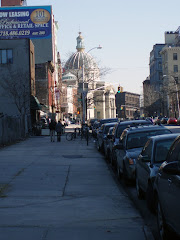
New on Grand Street


The first new place that's opened in Williamsburg in quite a while that seems interesting; as long as they don't make a habit of this private event thing.

How We Respect Our Heritage

And teach our children to respect theirs. The Williamsburg Bridge dedication plaques.


Tuesday, April 12, 2011

Also, a birthday


Just a note that on July 31, the McCarren Pool will be 75 years old, having opened on July 31, 1936.


1936 might be considered a sort of annus mirabilis of municipal pool construction in New York City. Between June 27 and August 17, through the efforts of Fiorello Laguardia, Robert Moses, and the WPA, ten pools were opened around the five boroughs, three of them in Brooklyn:

McCarren Pool in Greenpoint, July 31

Betsy Head Pool in Brownsville, August 7

Sol Goldman Pool in Red Hook, August 17


After being closed and neglected for almost 30 years, McCarren Pool is in the process of being rebuilt but won't be ready to reopen until the spring of 2012. McCarren Pool was the largest of the WPA pools constructed.


I wasn't able to find any "free" photos of McCarren Pool in its palmy days but, going back even further in time, I found a photograph* of the funeral of the pool's namesake, and I thought, what the hell.

*"McCarren Funeral 1909" is from the Bain Collction at the Library of Congress. Call #: LC-B2- 911-15 [P&P]

Patrick Henry McCarren was a local politician and a state senator who died in 1909 at the age of 62. Also, unlike some people with highways or parks or pools named after them, he actually was from the neighborhood. He lived at 97 Berry Street at the time of his death and his funeral was conducted in St. Vincent de Paul Church on North 6th between Driggs and Bedford Avenues. Sadly, or perhaps not, all the ivy in the photo above has been removed . . . but replaced by scaffolding.


By the way, anyone interested in the transformation of New York City under Robert Moses could do worse than get a copy of: Robert Moses and the Modern City: The Transformation of New York. Edited by Hilary Ballon and Kenneth T. Jackson, W.W. Norton, 2007.

It is a beautiful and comprehensive book covering Moses's career as master builder (for good or ill) in New York, and is lavishly illustrated with period and contemporary photos.

In the cross-hairs!

A week or so ago I was walking from Williamsburg to Flatbush for okra. Yes, people do that sort of thing; some people, anyway. There are a couple of vegetable places on Church Ave. near Ocean Avenue that have great deals on okra by the pound. In lots of places you're forced into buying those little cellophane-covered packages with six or eight pieces for a buck. Bah!

So, on my way along Bedford Ave. in Bed-Stuy, at the corner of Gates Ave. to be precise, I came cross this new . . . structure.


Check out the prices. FROM $195,000. I take it that means the lowest price? A studio?

I walk around and through Bed-Stuy quite a bit and I think I can venture a guess that very few people in the neighborhood could pony up the cash for a $195,000 condo, or anything close to it. But that's not really the point, is it?

It's in the way of an advisory for Bed-Stuy that it's now in the developers' cross-hairs. Watch out, Bed-Stuy, your days may be numbered, your neighborhood could be up for grabs before you know it; and chances are you won't be a winner.


Wednesday, April 6, 2011

Curiouser and Curiouser

Back in December, I mentioned that HSBC, who had maintained a branch in the landmarked original Williamsburgh Bank building at Driggs Ave. and Broadway, had suddenly decamped, removing all their garish 21st century signage, and opened a branch further north at Bedford Ave. and North 3rd Street.


Until February, the building stood empty and lifeless with no hint of what was to be done with it. It is landmarked both outside and inside so any owners' or tenants' options are limited, at least in the sense that the building can't be torn down. But even a cursory glance at "vintage" buildings in the city (and here in Brooklyn) should be enough to assure anyone that a late-19th-century, neoclassical building in pristine condition like this one could be, so to speak, money in the bank.


Then, at the beginning of February, a large white construction tarp appeared on the west side of the building, covering the entire side, with big "debris tubes" hanging out and leading to dumpsters below.


This was intriguing since I thought landmarked buildings had to be treated with white glove care. But I figured maybe they were just clearing out the upper floors of material that was easier to junk than move out.


I hadn't given it much notice over the past month until last weekend when, purely by accident, I noticed graffiti had suddenly appeared near a front cornice. Then, on looking closer, I realized that the wall where the graffiti had appeared shouldn't have been visible. They were tearing down part of the bank!


But before going off half-cocked and complaining to someone, I figured I should check up on the building's history just a bit. And, as it turns out, the section they are demolishing was never part of the original bank building at all, just a very cleverly designed addition in a similar style. Still, they have managed to damage part of the original cornice of the bank.


I don't have any photos of the bank when it was first built but I recalled a book I had gotten from the BPL that contained a sketch drawing of the bank in 1889 and also a sketch map of Broadway in 1893, both showing the bank without that addition. Whew!

The name of the book, by the way, is Brooklyn's Williamsburgh: A City within a City, Brian Merlis, Brooklyn: Israelowitz Pub., 2005. Brian Merlis has a whole raft of books of vintage photos of most neighborhoods in Brooklyn.

Now all I am wondering is why, if they are demolishing the damn thing, are they only demolishing the second and third floors and, apparently, keeping the first floor? I'm sure it would look better removed completely. Stay tuned.


Tuesday, March 22, 2011

New Building in Brooklyn

A couple of articles concerned with the new buildings going up in so many areas of the borough.

I'll add them without comment since anyone who has read any of my posts shouldn't have a difficult time guessing what my comments might be.

These are from The New York Times, which is turning "pay to read" on March 28, so if you want to check them out, do it before then. Though, if you paste the title of an article into Google you can sometimes find a free site reprinting it.


The Supersizer of Brooklyn

Click on this link.


How a Building Dispute Can Sink a Sale
Click on this link.

Wednesday, March 16, 2011

Gott strafe die Nachbar


I should be keeping up this damn blog far, far better than I have been. God knows I am out walking around the borough each weekend for hours now that the weather is improving. It’s not unusual for me to get home on Saturday afternoon with over 200 photos on the old point-and-shoot (not that all of them are very interesting). I have spent the past three weekends, post-library visit, wandering down through Park Slope into Gowanus, and thence to Cobble Hill, Carroll Gardens, Brooklyn Heights, Dumbo, and so on. Last weekend was part of Red Hook and a neighborhood I had never been in before, Columbia Street down along the waterfront.


But, when it comes to sitting down in front of the P.C. and sorting through the photos and resampling and color correcting and figuring on something to write, I need to concentrate my mind, and thereby hangs a problem. I have two annoying neighbors. One is annoying only occasionally and doesn’t really impinge upon my blogging to any great extent. The other, nearer, neighbor is annoying almost constantly. We share a tissue paper-thin common wall in a 100+-year-old building that was thrown up at a time when the loudest noise you might hear from a neighbor was a squalling baby.


I won’t go into details but suffice it to say that as soon as I sit down to work on the blog, something starts up. I hope the situation will be resolved sooner rather than later, but until something happens there, not much will be happening here.


As an inveterate reader of detective fiction and suspense, I used to come upon a phrase in older books that were set during World War I: Gott strafe England! Some Prussian character would often be screaming this while trying to drown or otherwise dispose of the book’s hero. All I can find to say now is Gott strafe die Nachbar!!


However, in view of the dismal tone of this posting, it seemed like a good opportunity to post some equally dismal photos. All the photos here show what Admirals’ Row in the Brooklyn Navy Yard has been reduced to. You might describe it as vandalism through malign neglect.


Despite pleas from preservationists, historians, architects, etc. the federal government at first, and later New York City when the Navy Yard fell into its hands, refused to do anything to either restore the houses or, at best, just contain their disintegration. (Admiral’s Row refers to a group of officers’ quarters that were built in one corner of the Navy Yard; they are along Nassau Street near Navy Street.)


The City, in the person of Michael Bloomberg, is interested in little but the absolute bottom-line commercial possibilities of the Navy Yard and lacked the foresight to see that those possibilities could have been greatly enhanced by a restoration of the Navy Yard to even a fraction of its former appearance.


Better to let Admiral’s Row molder into dust and be choked by vines and then torn down and replaced by some innocuous glass box.


I suppose if you’re William Wordsworth, there is a kind of beauty to these vine chocked ruins though it resembles Germany Year Zero more than the English Lake District.


Even a lick of blue paint on the gate posts or walls or a little rust proofing on the fences might prevent it becoming just another eyesore.


The Sands Street entrance once made a striking sight but after the police impound lot took over, “fuhget about it!” Those eagles will never soar again.


Sands Street entrance, 1904. From the collection of the Library of Congress.


The city is restoring one small building to act simply as an entrance to some jazzy construction. We should be grateful for tiny favors, I guess. But rather than a sop to our sensibilities, I really would rather be able to walk around inside or walk through the place. Instead it’s locked down like the equivalent of the Indian Point nuclear reactor.


There are businesses in there. Well, there are business establishments all over the city and they seem to survive without tall fences and guards. Suppose 5th Avenue were closed off because Tiffany is there?


An overview of the Navy Yard showing (yellow line) detour necessary because of Navy Yard lockout. Admiral's Row is at far left. The "C"-shaped building near the far right of the yard is the Old United States Naval Hospital and has been landmarked. I believe that is boarded up, too.


Washington Ave. runs through the Yard from Clinton Hill to Williamsburg; it’s practically a straight shot. But rather than let us walk through and save an enormous detour, we’re locked out for fear we might . . . what . . . riot and destroy the place? Give me a break. Open the damn thing up, Mike!


Top photo is view from Flushing Ave. across to Williamsburg; the large apartment block is at Kent Ave. Bottom photo is Williamsburg gate.